
Evidence
What entered the model and with which epistemic status.
The DCG Causal Sandbox explores how a structural laboratory can support intervention design: feedback, delay, adaptation, leverage and causal lineage before a consequential decision reaches the real system.
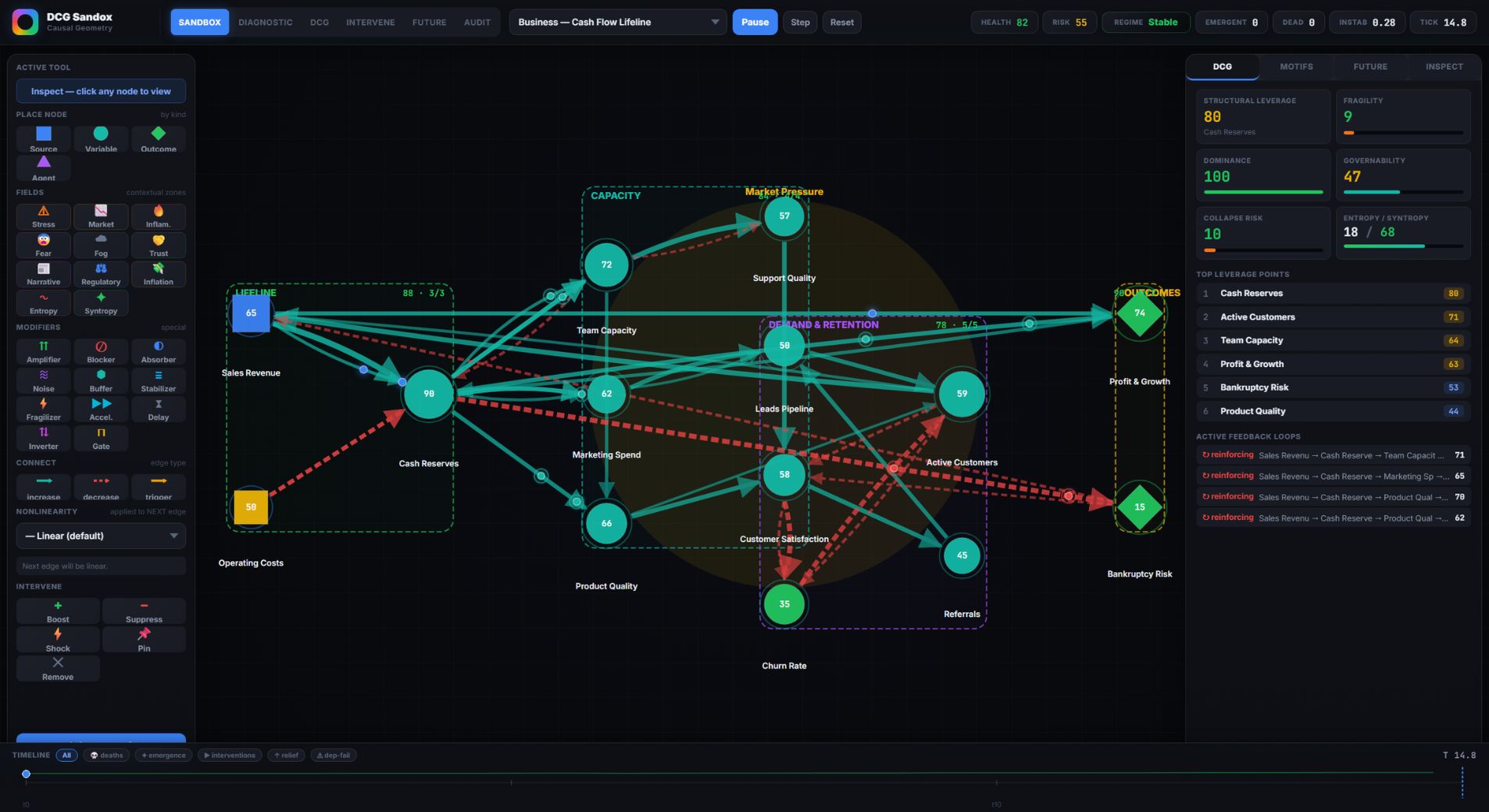
This page presents the capability through real interface images and its intended workflow. It does not launch a public simulator. The results of any working model depend on its rules, evidence and assumptions.
Relationships, delays, feedback and actor responses generate conditional trajectories. A useful run exposes why the system changed, what assumptions drove the result and where the model remains fragile.
A changed constraint or power configuration alters downstream relationships, accessibility and actor options.
Actors adapt to the new field. The sandbox carries that adaptation into subsequent consequences.
Effects propagate with different lags. A tactical gain may consume legitimacy, create resource debt, displace pressure or reinforce the next cycle of the problem.
The environment preserves the path from evidence and assumption to model change, intervention, observed response and revised understanding.
What entered the model and with which epistemic status.
Why a relationship or intervention was proposed.
What was altered, when and under which constraints.
What the response changed in the structural model.
Compare a baseline, an intervention and a designed non-intervention from the same decision frame. The objective is not certainty; it is to make assumptions, trade-offs and failure routes visible before commitment.
What becomes reinforced if the governing structure remains materially unchanged?
Which relationships move, how does the system adapt and what new liabilities appear?
Challenge the mechanism behind a proposed action.
Examine sequence, buffer and option combinations.
Find assumptions that dominate the result.
See how SGM configurations alter the field.
Identify signals that discriminate between hypotheses.
Keep the reasoning available to future decisions.
A useful briefing begins with the consequential problem, the authority to act and the uncertainty the institution needs to resolve.